Sieve Bend Screens (DSM Screens)
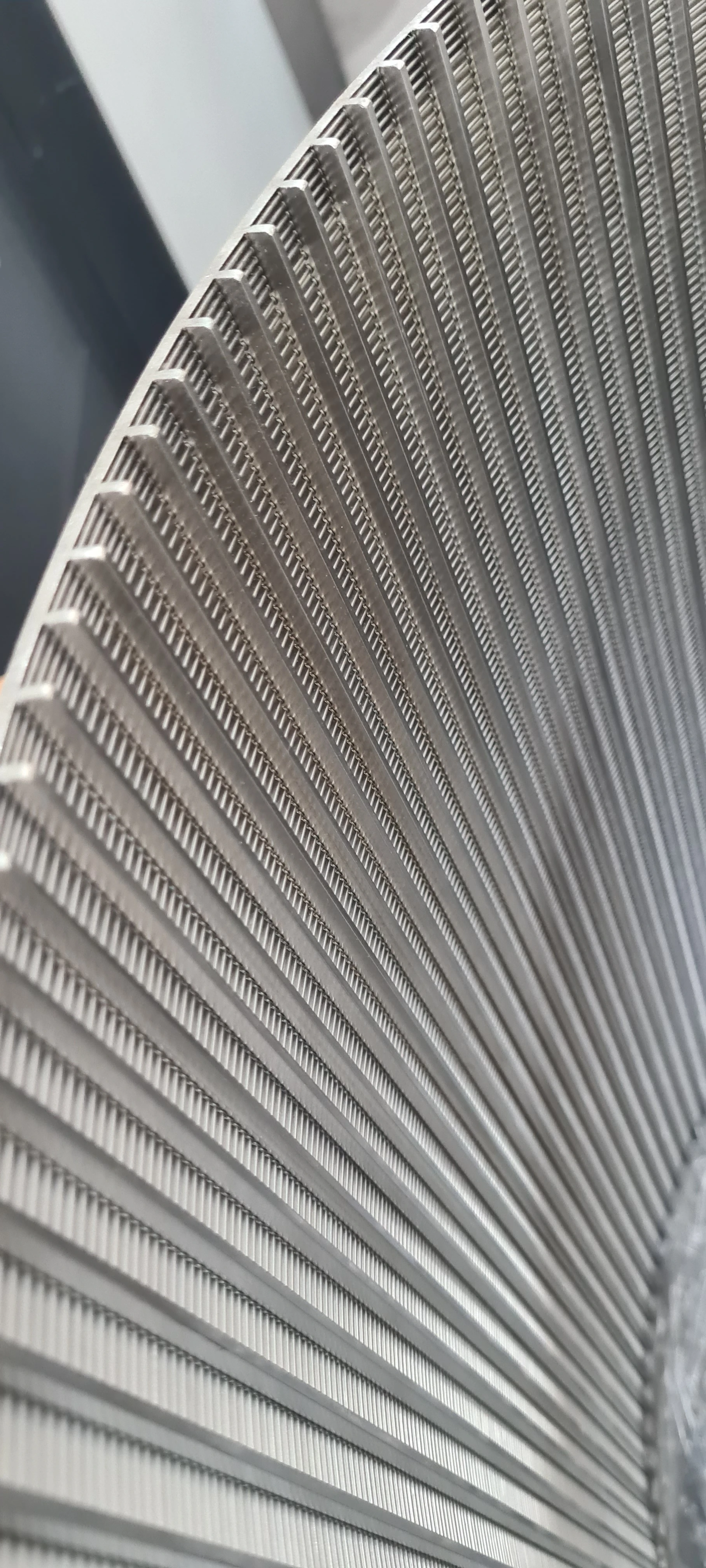
Curved static screen where slurry flows tangentially across the concave wedge wire surface; gravity carries liquid and fines through the slots while oversized solids slide off the discharge end. No moving parts, no energy input. High-capacity design outperforms flat panel alternatives in dewatering, sizing, and classification. Also known as DSM screen or bend screen.
Where sieve bend screens are used
• Dewatering & sizing
• Coal & mineral separation
• Food & starch processing
• Solid-liquid separation
Sieve bend screen materials
RELATED INDUSTRIES
Related Knowledge
WIRE PROFILES
SUPPORT RODS
Sieve bend screen specifications
MATERIAL SPECIFICATIONS
Indicative values. Specific service limits depend on operating chemistry, temperature, and stress state. Material certification per EN 10204 Type 3.1 supplied with order.
| Material | UNS / EN | PREN | Chloride | Max Temp |
|---|---|---|---|---|
| SS 304 | S30400 / 1.4301 | 18–20 | ≤ 200 ppm | ≤ 400 °C |
| SS 304L | S30403 / 1.4307 | 18–20 | ≤ 200 ppm | ≤ 400 °C |
| SS 316 | S31600 / 1.4401 | 24–26 | ≤ 1000 ppm | ≤ 450 °C |
| SS 316L | S31603 / 1.4404 | 24–26 | ≤ 1000 ppm | ≤ 450 °C |
| SS 316Ti | S31635 / 1.4571 | 24–26 | ≤ 1000 ppm | ≤ 550 °C |
| Duplex | S32205 / 1.4462 | 33–38 | Brackish/seawater (limited) | ≤ 300 °C |
| Super Duplex | S32750 / 1.4410 | ≥ 40 | Seawater compatible | ≤ 300 °C |
MANUFACTURING TOLERANCES
Standard manufacturing tolerances. Tighter tolerances available on request and confirmed at order entry.
| Slot Range | Slot Tolerance |
|---|---|
| 0.02 – 0.10 mm | ± 0.005 mm |
| 0.10 – 0.50 mm | ± 0.01 mm |
| 0.50 – 2.00 mm | ± 0.03 mm |
| 2.00 – 10.0 mm | ± 0.10 mm |
| > 10.0 mm | ± 0.20 mm |
How a sieve bend screen works
A sieve bend is a curved, static wedge wire panel. Slurry is fed tangentially onto the top of the concave face and runs down the arc as a thin film. Each tilted wire edge shears a layer of liquid off the underside of that film, and the liquid follows the curved wire through the slot (the Coanda effect). Solids keep moving across the wire tops and leave at the discharge end.
The tilt is what gives a sieve bend its capacity per square metre. Without it the panel would behave like a plain static screen. With it, a sieve bend separates particles at about half the slot aperture, and it does so with no moving parts and no power supply. The other common name, DSM screen, refers to Dutch State Mines, whose coal dewatering research set the original design at a 10 degree tilt on a 30-inch radius.
Choosing a sieve bend: radius, slot, wire tilt and material
On the drawing, a sieve bend is defined by its radius of curvature, arc length, width, slot aperture and wire tilt. The radius is typically 500 to 1500 mm. Arc length, width and the mounting angle of the frame are set per application, and for a replacement panel they are taken from the screen already in service.
Size the slot from the cut point you need. Because the wires are tilted, the separation happens at roughly half the slot aperture, so the slot is wider than the particles you want to remove. We work from your particle size distribution (sieve analysis or laser diffraction), solids concentration and flow rate. Slot tolerances follow the manufacturing tolerance table above.
Tilt angle is specified on the drawing and checked in production with precision angle gauges, to a tolerance of about plus or minus 1 degree. A variation of more than 2 degrees between wires gives uneven separation and local wear. Typical ranges by duty:
| Duty | Wire tilt |
|---|---|
| Mineral processing | 8-12° |
| Food and starch processing | 10-15° |
| Wastewater screening | 5-8° |
Grade follows the medium. Food, starch and sugar duty is built in SS 316L. For chloride-bearing water, SS 304L suits fresh water below about 200 ppm chloride, SS 316L handles roughly 1,000 ppm at ambient temperature, Duplex 2205 takes up to 3,600 ppm, and Super Duplex is the grade for seawater.
Sieve bend vs flat screen
Both dewater and size, but they separate in different ways. A sieve bend uses gravity and the flow of slurry across a curved surface, with no power input. A flat panel sits on a vibrating deck, a shaker table or a static drain, relies on vibration or gravity, and has its support bar spacing calculated for vibration loads. If the material flows by gravity across a curved surface, the answer is a sieve bend; if it sits on a vibrating flat surface, a flat panel.
The full comparison is in our article Sieve Bend vs Flat Panel: When to Use Which.
Applications of sieve bend (DSM) screens
The same curved panel runs in mines, food plants and treatment works. These are the duties we build sieve bends for:
| Sector | What the sieve bend does |
|---|---|
| Mining and minerals | Removes water from mineral slurries, sizes particles, and washes and classifies aggregate. |
| Coal | Gravity separation of coal and reject. Coal dewatering is the duty the original DSM research was done for. |
| Starch and food | Starch washing, fiber separation and protein recovery; juice extraction and pulp separation. |
| Sugar | Separates extracted juice from beet cossettes or cane fiber, and filters carbonatation mud. |
| Pulp and paper | Gravity-fed pulp dewatering. |
| Wastewater | Sludge dewatering at treatment plants and screening of industrial effluent. |
Sieve bend screen FAQ
What is a DSM screen?
DSM screen is another name for a sieve bend: a curved, static wedge wire screen fed with slurry at the top, which lets liquid and fines pass through the slots while solids slide off the discharge end. DSM stands for Dutch State Mines, whose coal dewatering research set the original design. Bend screen and static sieve bend mean the same equipment.
How do I choose the slot size for a sieve bend screen?
Start from the cut point. With tilted wires a sieve bend separates at about half the slot aperture, so the slot is wider than the particle size you want to remove. We size it from your particle size distribution, solids concentration and flow rate. For a replacement, the slot width of the current screen and how well it separates are the best starting data.
What wire tilt angle does a sieve bend need?
It depends on the duty. Mineral processing usually runs at 8-12 degrees, food and starch processing at 10-15 degrees, and wastewater screening at 5-8 degrees. We hold the tilt to about plus or minus 1 degree, because more than 2 degrees of variation between wires gives uneven separation and local wear.
What do you need from me to make a replacement sieve bend?
Measure the arc radius, arc length, width and mounting angle of the existing panel, and send photographs with the measurements. Add the slot width if you know it and the make and model of the equipment it fits. We build the replacement to those dimensions.
Which material should a sieve bend screen be made of?
We build sieve bends in SS 304, 304L, 316, 316L, 316Ti, Duplex and Super Duplex. Food, starch and sugar plants take SS 316L. For mine and process water the deciding figure is chloride: SS 304L for fresh water below about 200 ppm, SS 316L up to roughly 1,000 ppm at ambient temperature, Duplex 2205 up to 3,600 ppm, and Super Duplex for seawater.
Need a Custom Screen? Send Us Your Specs.
Describe your application, operating environment, and dimensional requirements. Our engineering team will respond within one business day.
SEND AN INQUIRY